New prints - November 2001
| More artwork is on its way!
In our recent travels we have been pleased to be invited into classes to sketch and work on artwork. In this photograph, you can see the drypoint needle and copper plate from the artist's point of view in a ballet class. It is extremely gratifying to be able to share these classic moments with the public. From the sketches on paper and in copper drypoint, as well as from the photographs taken in class many more pieces of artwork may be developed. None of these images would be possible without the kind cooperation of the ballet studios and their personnel. These include Ballet El Paso, Ballet Austin, Champion Studios (El Paso) and many others. | 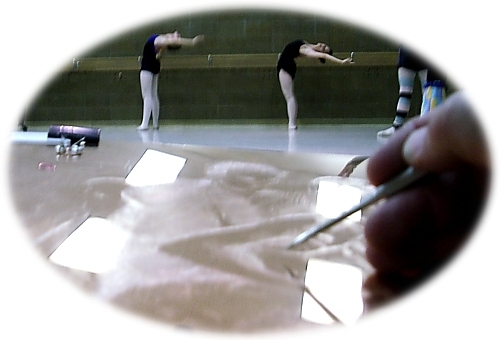
| |
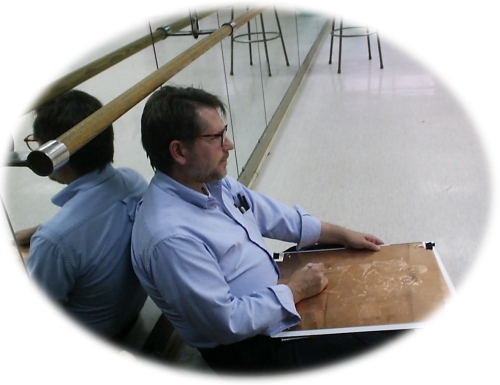 In the image to the left, artist B. H. Giza can be seen working on a copper drypoint image while watching a ballet class. A tool-steel engraving tool is used as a drawing instrument. The image will then be inked and run through a printing press to transfer the image to high-quality print paper. In the image to the left, artist B. H. Giza can be seen working on a copper drypoint image while watching a ballet class. A tool-steel engraving tool is used as a drawing instrument. The image will then be inked and run through a printing press to transfer the image to high-quality print paper. | ||
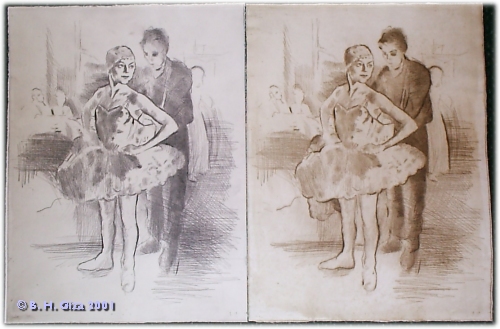
Periodically, the work is proofed on a press to help the artist understand how each stage translates from copper to paper. In the image above you can see this process of stage-proofing taking place. These are early stages of a drypoint (direct drawing with a needle on copper). On the left, the composition has been worked out and the modeling of the figures has begun. About a week later, in a second stage proof, seen on the right, additional components have been added. For example: The dancer may now be seen to be grasping her warm-ups in her right hand, and the left foot of the dresser has been slightly re-positioned and delineated. Over-all the composition is being worked from light to dark. This shows one of the secrets of the drypoint technique. Although lines scratched into the copper may not be removed, the composition may be re-worked by the artist by adding shadows or changing areas of dark and light. In the final proof, the viewer will probably never be able to detect the large number of changes the print goes through while it is being drawn, and they might assume that the image was produced in some effortless feat of draftsmanship. Actually, the printmaking process is particularly exciting to many artists because they can only see it on paper in sequential stages, allowing them to "re-discover" their images and keeping the design a series of fresh challenges over time. | ||
Link to the second November, 2001 prints page
Back to the BalletArt.Com Home Page
All content and images copyright © 2001 B. H. Giza. All rights reserved